
General
7 AI Trends Reshaping Ecommerce 2026
AI is reshaping e-commerce faster than most retailers are ready for. Here are the 7 trends you need to know:
- Studio-quality content – AI tools now generate product visuals and copy at scale, without a photoshoot
- AI virtual try-ons – Shoppers can see products on themselves before buying, reducing returns
- AI personalisation – Every visitor gets a unique storefront experience based on their behaviour
- Chatbot shopping – Conversational AI guides customers from discovery to checkout
- AEO for visibility – Optimising for AI search engines is now as critical as traditional SEO
- AI as the buyer – Autonomous agents are beginning to make purchasing decisions on behalf of consumers
- Own the sales journey – Brands that control their direct channel will win as AI intermediaries grow
I’m going to be discussing 7 AI trends reshaping e-commerce.
Were going to start with something a bit unsettling, and that is half of what I could have told you about AI in ecommerce six months ago is already wrong.
Not refined but wrong. In just the last year, the most hyped feature in the space launched and was killed: ChatGPT Instant Checkout. Walmart tore up its entire AI strategy and rebuilt it. Google quietly added a button that lets it buy things for you. This isn’t a field that’s evolving. It’s a field that’s churning fast, and the ground is moving under every e-commerce store on the web, including the sophisticated ones.
So I’m not going to give you a ‘what is AI’ talk, as you’re well past that. I’m going to give you the seven trends actually reshaping how people shop right now, in the state they’re in this week.
We’ll move from the ones quietly embedded in e-commerce stores already, through to a couple that I think will surprise even the people here who follow this closely.
Trend 1: Studio-quality content at near-zero cost
Trend one is the one you can feel immediately. Everything that used to need that studio, product photos, descriptions, video ads, voiceovers, an AI does now, for almost nothing.
And it’s not a new thing; around 80% of consumers say they plan to use generative AI while shopping this year, so customers are already living in this world.
Here’s why it matters more than just ‘it’s cheaper.’ It’s not that you save money, it’s that the gap between a big brand’s content and a smaller brand has disappeared.
A one-person store can now look exactly as polished as a company with a million-dollar creative department. That used to be a real competitive moat. It’s gone.
Which means looking professional is no longer the edge; it’s now the baseline. If store content still looks homemade, that’s now a choice, not a constraint.
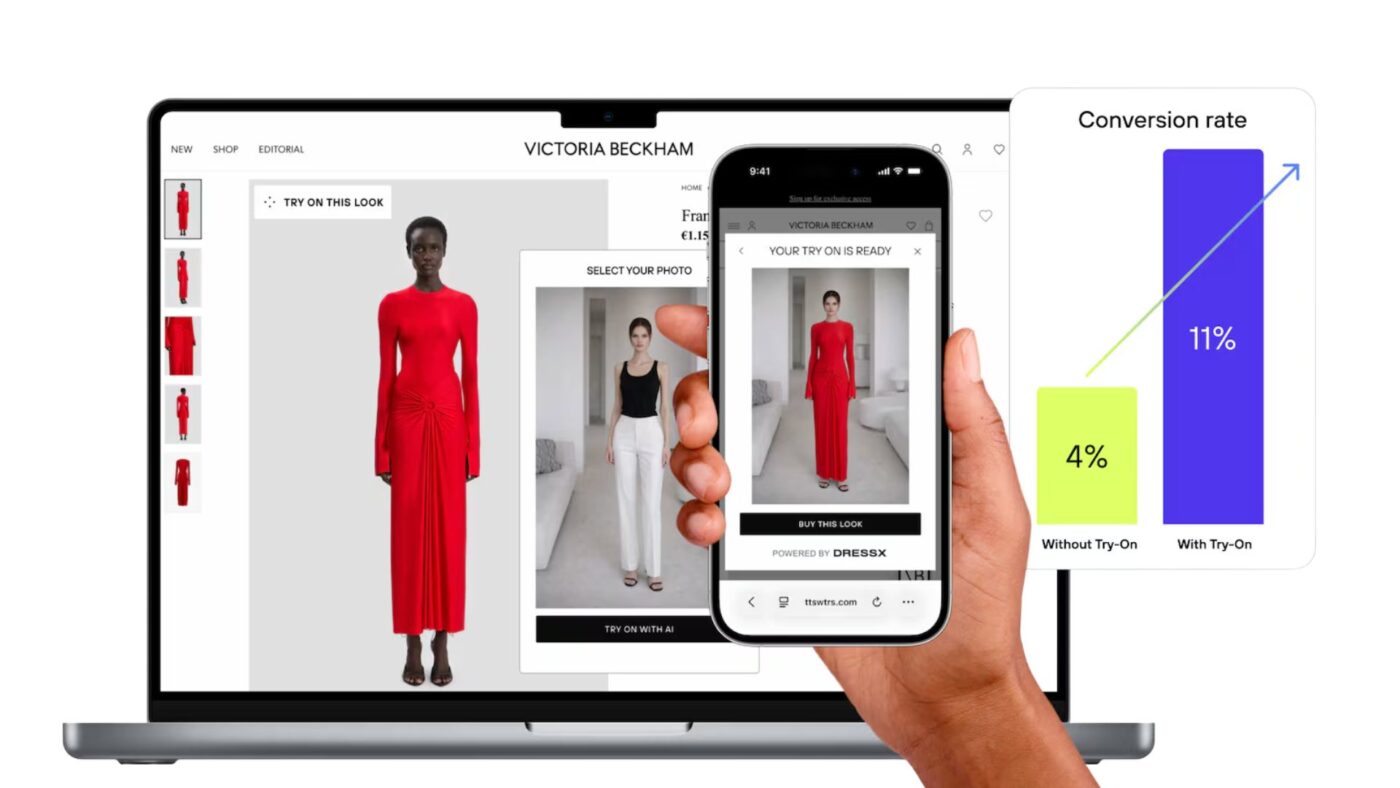
Trend 2: See it on before you buy it – AI virtual try-on
Trend two stays on what AI can make for you, but this one’s about removing the single biggest reason people don’t buy online. Think about it: the number-one hesitation in ecommerce has always been ‘will this actually look right on me, or in my space?’ You can’t try it on through a screen. So people hesitate, they don’t buy, or they buy three sizes and send two back.
AI virtual try-on kills that hesitation. From a single photo, a shopper can now see the product on themselves, the jacket, the sunglasses, the trainers, or see how a couch actually sits in their own lounge. Not on a generic model but on them.
While AI agents are disrupting how customers discover, select, and purchase goods, AI-powered virtual try-ons could be the antidote to e-commerce’s conversion, retention, and return rates.
And the numbers are striking. DressX, who build this technology, found that shoppers who use try-on are 50% more likely to buy, and in luxury, conversion jumps up to ten times higher. Returns are pure margin leaking out the back door, and try-on plugs it, because people order the right thing the first time.
And this is already being rolled out by the likes of Zara. The big luxury platforms have made it standard. So if you sell anything someone wears, or anything that goes in a room, the question has flipped, it’s not ‘should we offer try-on?’, it’s ‘why are we still asking customers to guess?
Trend 3: AI behind your counter, 24/7
Trend three, is AI working your shop floor.
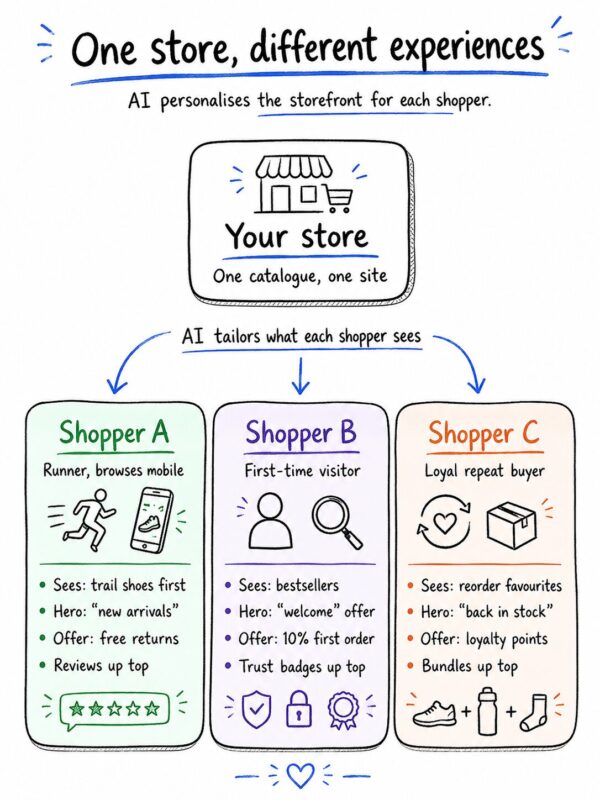
AI quietly does two jobs behind the counter, day and night, so every shopper gets a store that feels made for them. That’s the new normal.
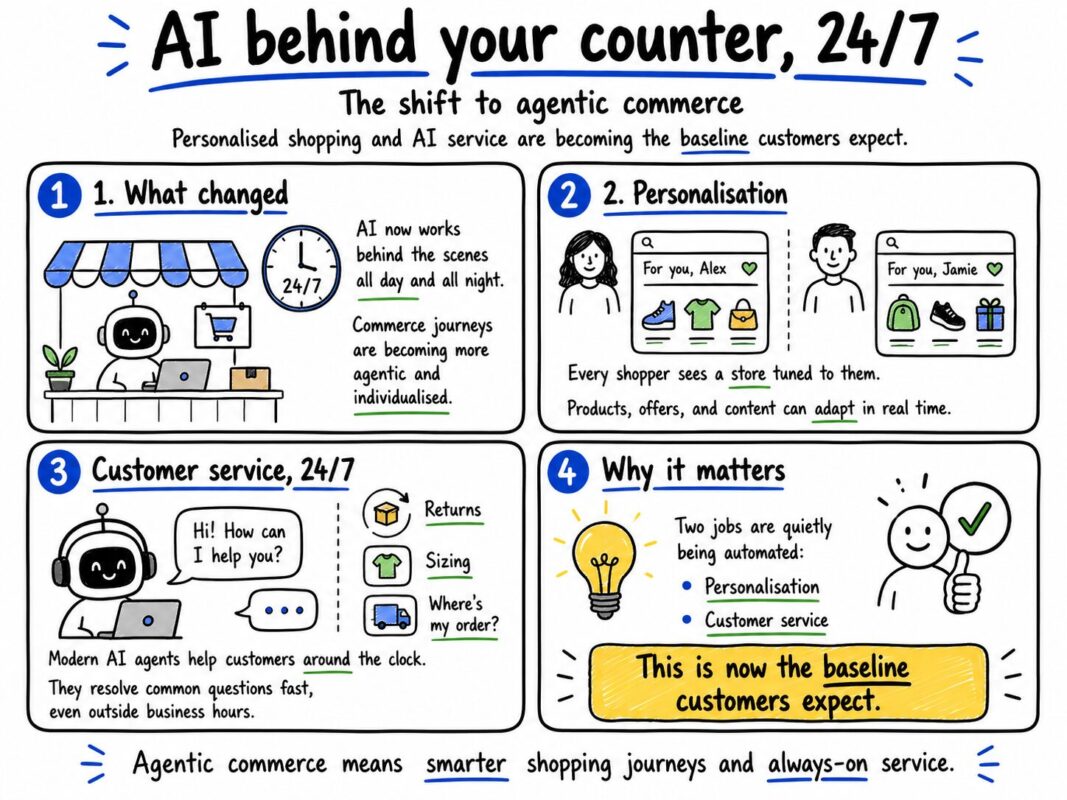
First, personalisation. When you land on Amazon, you are not seeing the same shop as the person next to you. The homepage, the products pushed forward, even some offers, all tailored to you by AI. And it’s not a gimmick: somewhere around a third of Amazon’s sales come from those AI recommendations. The store quietly rearranges itself for every single visitor; you can see that in the right image here, the same store showing a different face to a runner, a first-timer, and a loyal buyer.
Second, customer service. And I know, we all remember the old chatbot that understood nothing and just made you angrier. That’s gone. Today’s AI service agents can genuinely resolve things: returns, sizing, ‘where’s my order’, at two in the morning, no human needed, and often the customer can’t tell. For a small store, this is the cheapest, most patient team member they’ll ever hire.
Here’s the catch, and it’s the important bit: customers now expect both of these. Personalisation and instant answers don’t delight people anymore; they’re the floor. Don’t offer them, and you don’t feel behind the times; you just feel behind. That’s how far we’ve come: what was futuristic three years ago is just the price of entry now.
Now, let’s get to where AI starts to really affect e-commerce stores.
Trend 4: Shopping starts in a chatbot, not Google
Trend four and this is where it gets serious for e-commerce stores. It’s about where shopping begins now.
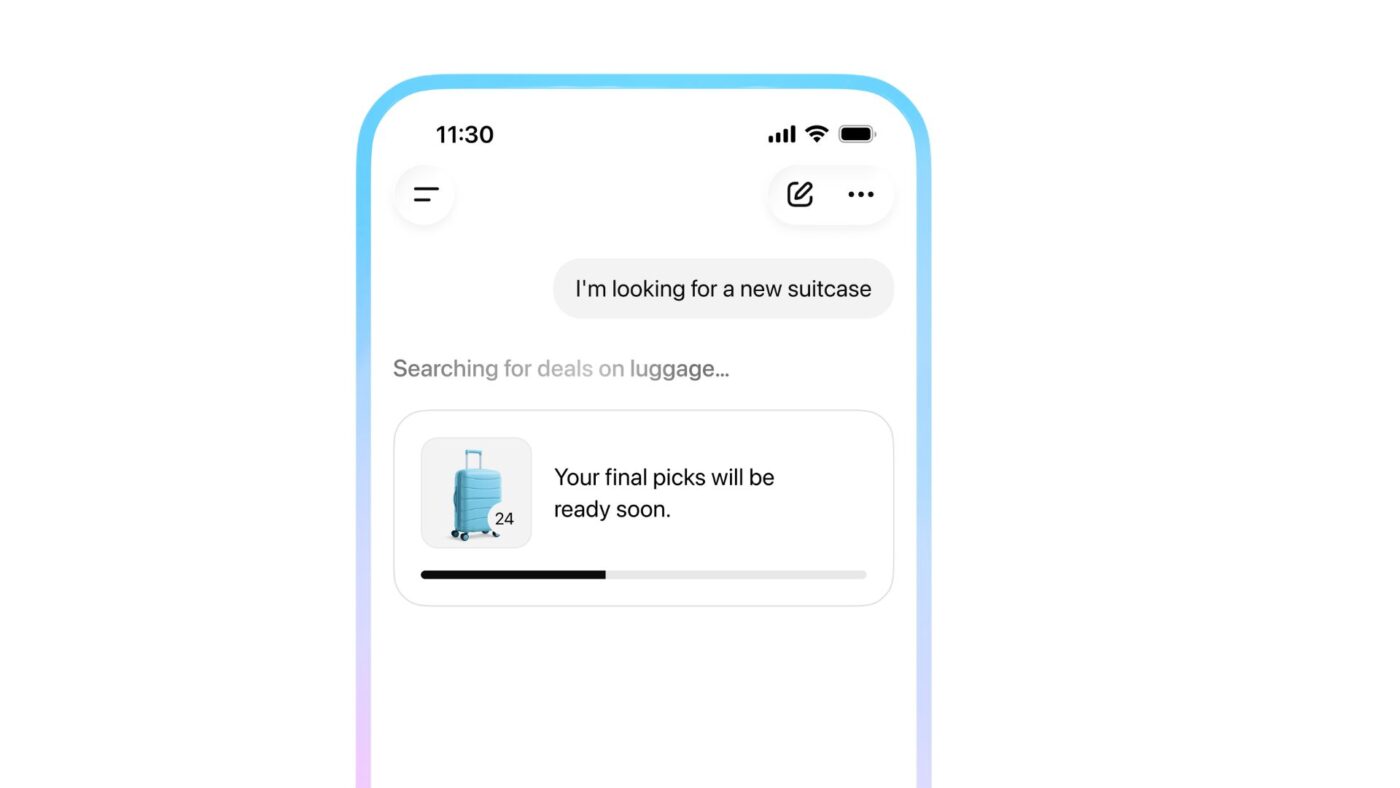
For twenty years, the journey was the same. Someone wants a suitcase; they go to Google, type ‘best suitcase’, get a page of 10 links, and your store is one of them. E-commerce stores had a shot. They were in the room, in the line-up, with a chance to be clicked.
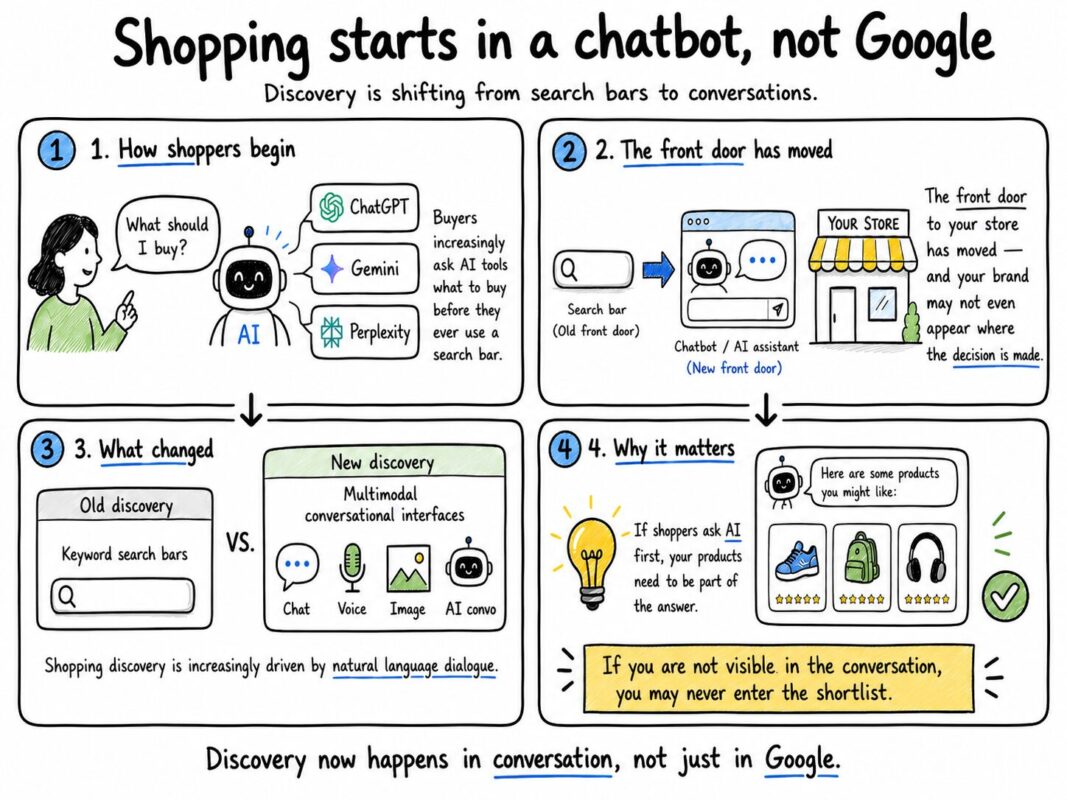
Now look at what’s happening, you can see it on the diagram here. People don’t start at Google. They open ChatGPT, or Gemini, or Perplexity, and they ask like they’d ask a friend: ‘I’m looking for a new suitcase, what should I get?’ And the AI doesn’t hand back ten links. It hands back an answer. Maybe one product. And if you’re not that answer, the shopper never even knew you existed. They didn’t lose the sale. They were never in the room.
And this isn’t a trickle. Adobe tracked AI-driven traffic to retail sites growing 393% year on year, off more than a trillion website visits, so this is real, measured data, not a survey. The front door to ecommerce stores has moved, and most owners haven’t noticed it yet.
Trend 5: Getting found by AI (AEO/GEO)
So trend four was the scary one. AI might recommend a product but leave many stores out entirely. Personally, trend five is my favourite and I spend a huge amount of time on this daily. Trend five is the answer to fixing trend 4.
If AI is the thing recommending products now, store owners’ jobs are simple to say and powerful to do: they need the AI to recommend them.
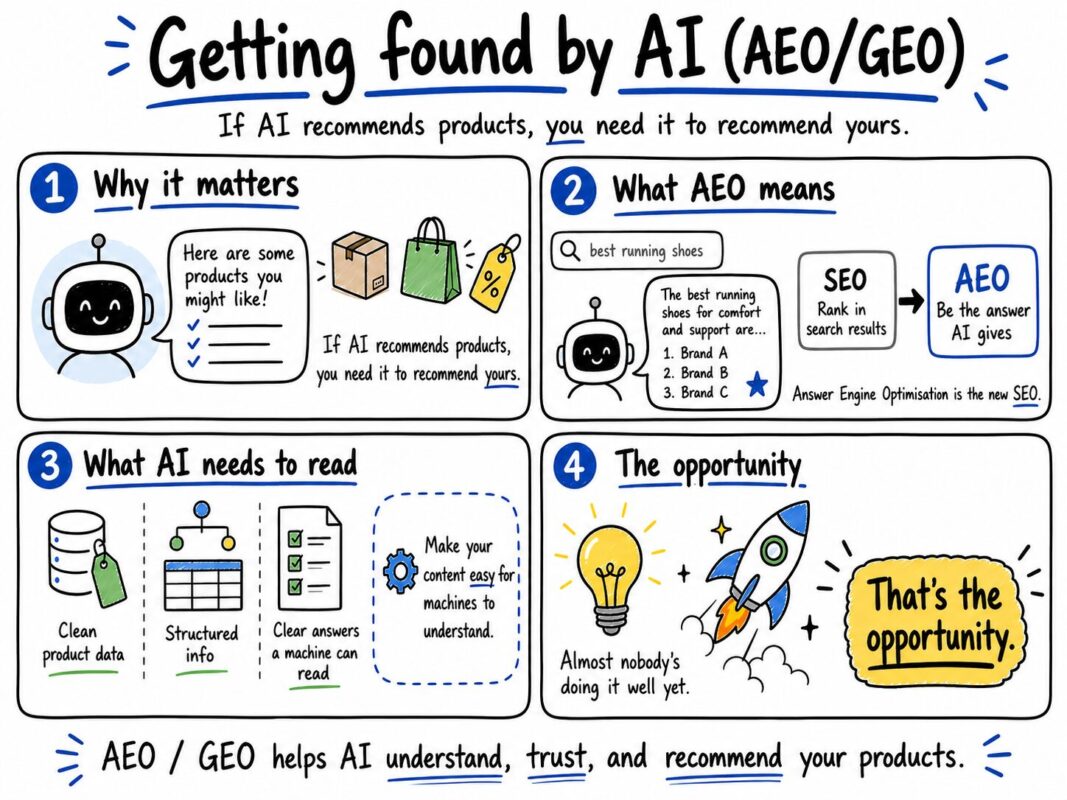
And that has a name; AEO, Answer Engine Optimisation. Some people call it GEO, too. Think of it as the new SEO. Same goal, to be findable, but instead of climbing a list of links, stores are trying to be understood and chosen by a machine. Stores need to optimise to be the answer the AI gives.
And the way they do that isn’t technical wizardry, it’s making stores legible to a machine using Clean product data. Clear specs. Plain-language answers to the questions people actually ask. When listings are vague like ‘item 4471, blue,’ the AI can’t tell what it is, so it skips it. When it’s clear, giving the name, the specs, waterproof, the size, the price, the AI understands it and recommends it. That’s AEO.
And here’s the opportunity: hardly anyone is doing this well yet which is exactly why it’s an e-commerce stores opportunity.
Fewer than one in ten retail sites are properly structured for AI to read them. So this is wide open. Stores Cleaning up their product data will genuinely be the highest-value afternoon’s work most of them could do this quarter.
Trend 6: The buyer is now a bot – and it’s a three-way race
Trend six. Everything so far still had a human doing the shopping, AI was just helping. This is the trend that changes. Here, the AI isn’t helping the shopper. The AI is the shopper. This is genuinely agentic commerce, software acting and buying on a person’s behalf.
And right now there’s a real three-way race to own it.
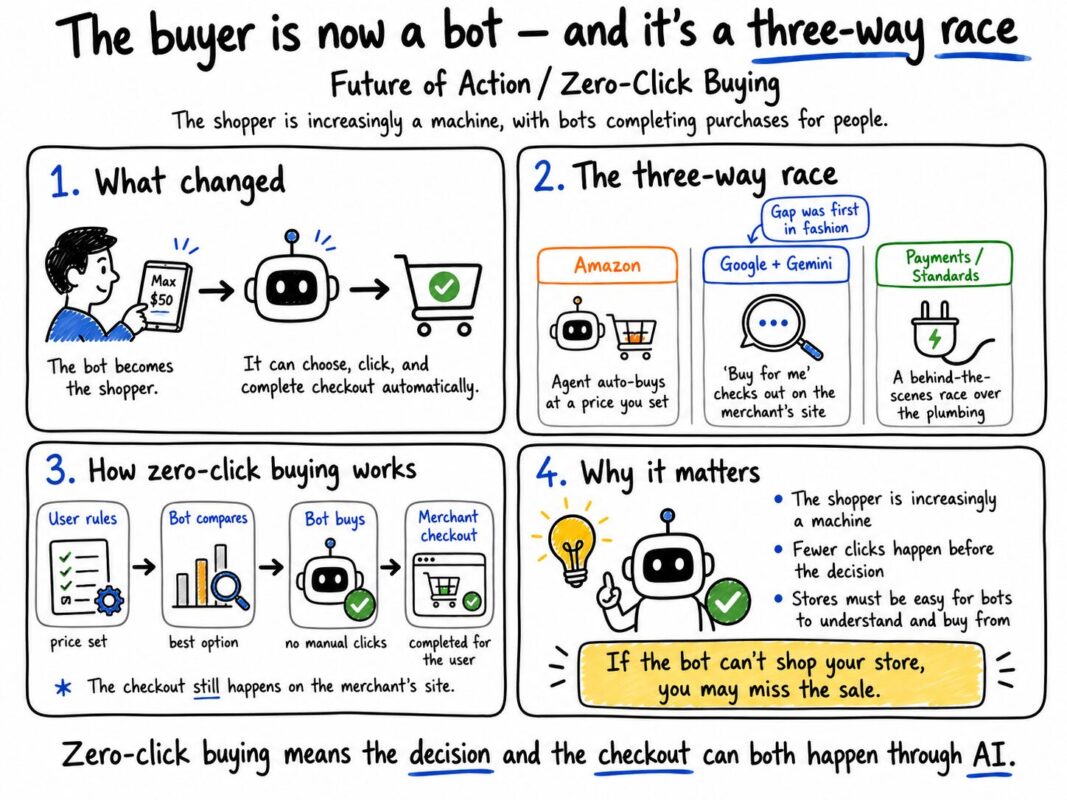
Amazon’s agent will literally buy something for you. You set a target price, it watches, and when the price hits, it checks out on your behalf. Over 250 million people used it in a single year. Google has put a ‘Buy for me’ button right inside Search and inside Gemini, it goes to the merchant’s website and completes the purchase for you; Gap was the first big fashion brand to wire into it. And there’s even a quiet standards war behind the scenes over the payment plumbing that lets these agents transact safely. Rival systems are already forming, and most stores will end up supporting more than one. You don’t need to understand the plumbing. You just need to know it’s being built right now.
And this isn’t a someday story. Morgan Stanley thinks roughly half of online shoppers will be using AI agents to shop by 2030. So picture what that means: customers may never see websites’ beautiful product pages, their photography, their clever copy. An AI sees it for them and decides.
Three big players racing to own it: Amazon, Google, and the payment standards underneath. But notice that last detail, the checkout still happens on the merchant’s site. Hold onto that, because it’s the twist in the next trend.
Trend 7: The plot twist: owning the journey wins
So that’s the scary version, the bots are taking over the buying. Trend seven is the plot twist, and it’s the most reassuring thing I’ll tell you today if you’re a store owner. The hype says AI is going to swallow your storefront whole. The truth is far more interesting, and one company lived the entire story for us: Walmart.
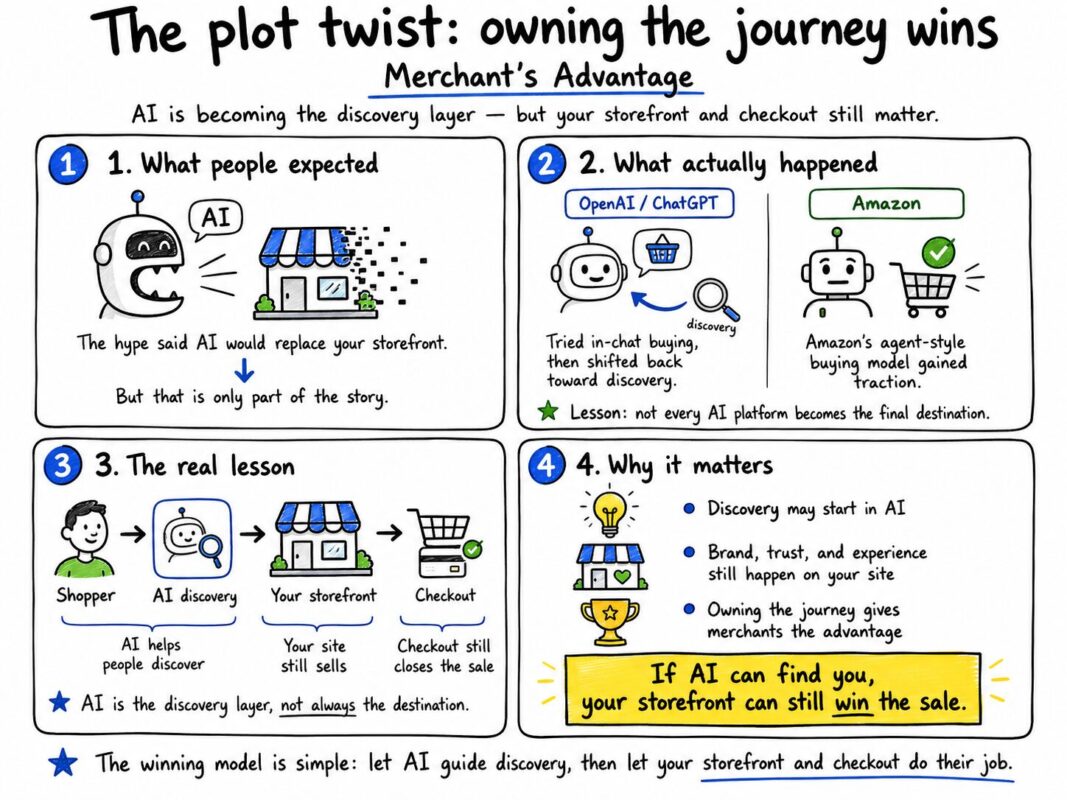
Here’s what happened. OpenAI built a feature that lets you buy things right inside ChatGPT, no leaving the chat. Walmart jumped in early, put around 200,000 products into it from late 2025. Sounds like the future. Except it flopped – hard. Conversion was about three times worse than when shoppers just clicked through to Walmart’s own site. Wrong items landed in carts. A Walmart executive flat-out called the experience ‘disappointing.’ And within about five months, OpenAI pulled the whole in-chat checkout and pivoted back to just helping people discover products.
Now here’s the clever part. Walmart didn’t retreat from AI, they flipped it. They took their own assistant, Sparky, and embedded it inside ChatGPT and Gemini. But the buying still happens on Walmart’s system, with Walmart’s account and Walmart’s data. They use the AI platforms for reach, to be discovered and to keep control of the actual sale. And it’s working: Sparky shoppers spend about 35% more per order than everyone else.
So here’s the lesson: AI is becoming the layer where people discover e-commerce stores. It is not the place they buy. Your storefront, your checkout, your relationship with the customer, those still matter. They might matter more than ever. The winners won’t be the ones who hand everything over to a chatbot. They’ll be the ones who let AI bring people to the door, and then own everything that happens once they’re inside.
Discovery may start in AI, but your storefront still sells, and your checkout still closes the sale. If AI can find you, your store can still win the sale. That’s the whole point.
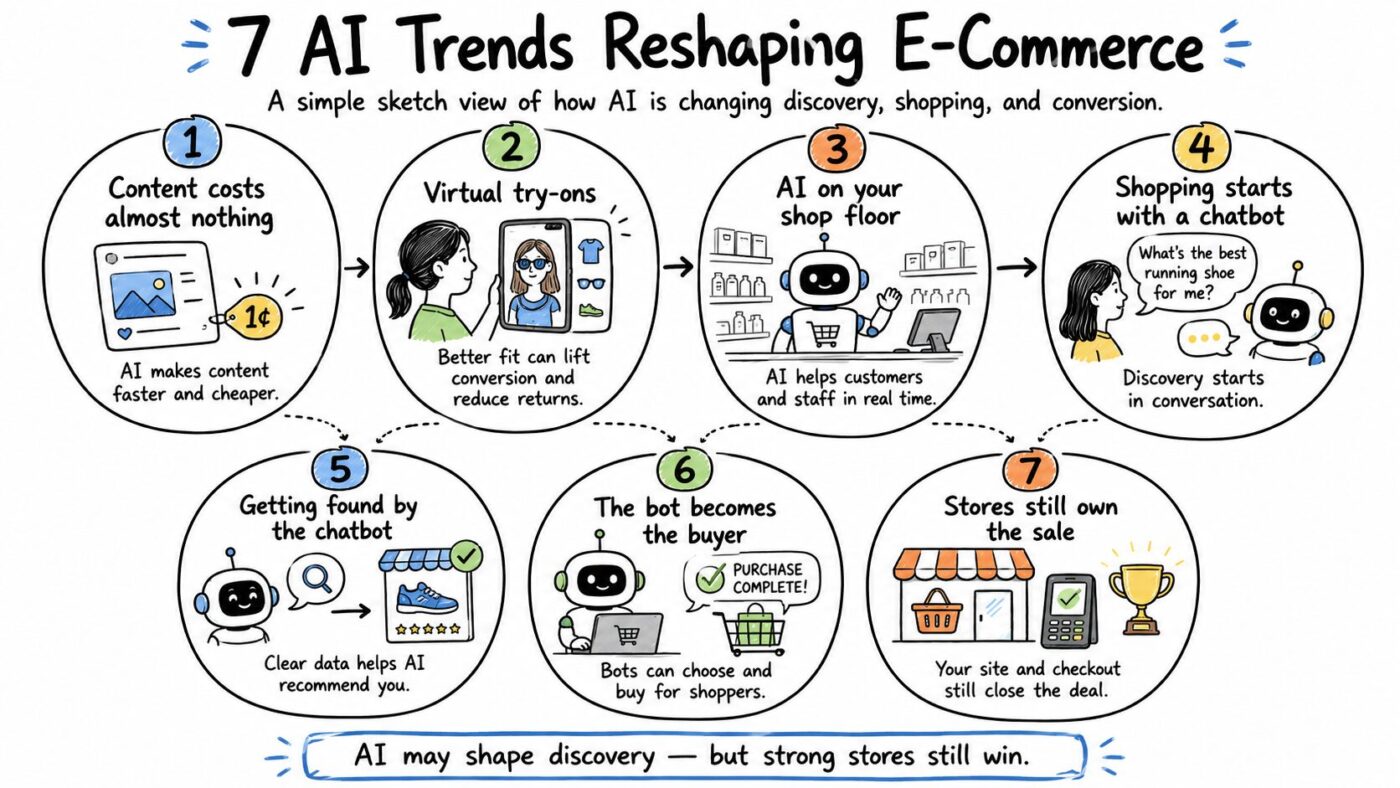
So seven trends. Content that costs almost nothing. AI-powered virtual try-ons could be the antidote to e-commerce’s conversion, retention, and return rates. AI is working your shop floor. Shopping that starts with a chatbot. Getting found by that chatbot. The bot is becoming the buyer. And the reminder that e-commerce stores still own the sale. Seven trends, but honestly, they all point to one single job.
E-commerce owners need to make their stores easy for AI to find, understand, and sell. That’s it. That’s the whole game. Everything we covered comes back to that one sentence.
And here’s the most encouraging number I came across. Around 85% of retailers say they’re exploring AI, but fewer than one in ten % have done anything real with it yet. That gap, between everyone talking and almost nobody acting, that gap is an e-commerce store owner’s head start. They don’t have to be a tech genius. You saw that you can build a professional photoshoot in under a few minutes. They don’t have to win the future today. They just have to start before that window closes. And right now, it’s wide open.
I opened by saying the ground is moving under every ecommerce store. It is but that’s the opportunity, not the threat. The stores that win won’t be the ones who saw it coming. They’ll be the ones who moved first.
